
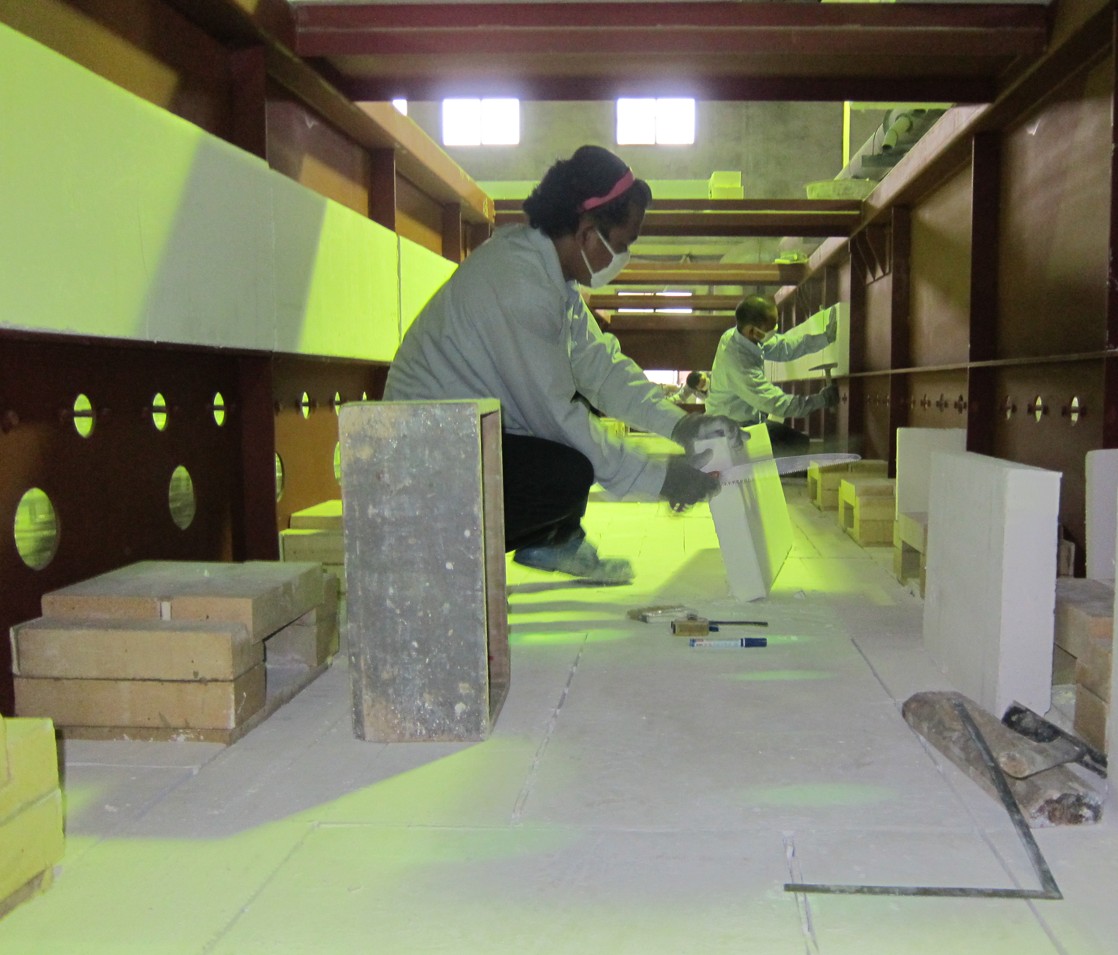
Every industrial furnace loses heat. The question is how much — and how much that heat loss costs you every month in wasted fuel, reduced throughput, uneven heating, and shortened equipment life.
Calcium silicate insulation board has been the backup insulation material of choice for industrial furnaces across virtually every manufacturing sector for decades. It sits behind the refractory hot face, forming a thermal barrier that keeps heat inside the furnace where it belongs and protects the steel shell from temperatures that would cause warping, oxidation, and structural failure.
But not all furnaces are the same, and not all calcium silicate boards are interchangeable. Choosing the wrong density, thickness, or grade for your specific furnace type wastes money — either through unnecessary material cost or through inadequate insulation performance.
This guide helps you make the right choice. We cover the most common industrial furnace types, explain which calcium silicate board grade works best in each application, and provide the technical reasoning behind each recommendation.
Understanding the Role of Backup Insulation in a Furnace Wall
A typical industrial furnace wall has three layers:
Hot Face — The refractory layer that directly faces the furnace interior and withstands the highest temperatures. Made of dense firebrick, castable refractory, or ceramic fiber modules depending on furnace type and temperature.
Backup Insulation — The intermediate layer that reduces heat flow from the hot face to the outer shell. This is where calcium silicate board is installed. Its job is not to withstand the maximum furnace temperature directly, but to reduce the amount of heat that reaches the steel shell.
Steel Shell — The structural outer wall of the furnace. Must be kept below approximately 200–300°C to maintain structural integrity and prevent worker burn injuries.
The backup insulation layer is arguably the most important layer for energy efficiency. The hot face refractory is selected primarily for chemical and mechanical resistance to the furnace contents. The backup insulation is selected primarily for thermal performance — its thermal conductivity directly determines how much energy escapes through the furnace walls.
This is where calcium silicate board excels. With thermal conductivity as low as 0.06 W/m·K at 200°C (for the 220 kg/m³ grade), it is one of the most thermally efficient rigid insulation materials available for temperatures up to 1100°C.
Which Density Grade for Which Furnace?
HR RHINO manufactures calcium silicate boards in six standard density grades, each optimized for different temperature ranges and mechanical requirements. Here is how to match the grade to your furnace type:
220 kg/m³ — Maximum Insulation Efficiency
Thermal conductivity: ≤ 0.06 W/m·K (200°C)
Best for: Furnaces where the insulation layer temperature stays below 600°C and maximum thermal efficiency is the priority.
Typical applications: Outer insulation layers in multi-layer furnace walls, low-temperature ovens and dryers, ductwork insulation.
Why this grade: At the lowest density in the range, the 220 grade traps the most air within its structure, giving it the best insulating performance per unit thickness. If your furnace design allows it, this grade delivers the most energy savings per dollar spent on insulation.
250 kg/m³ — Versatile Light-Duty
Thermal conductivity: ≤ 0.07 W/m·K (200°C)
Best for: Heat treatment furnaces, tempering ovens, and industrial dryers operating at moderate temperatures.
Typical applications: Box furnaces for heat treating steel parts, paint curing ovens, food processing ovens, laboratory furnaces.
Why this grade: Slightly denser than the 220 grade, providing better mechanical handling durability while maintaining excellent thermal performance. The go-to grade for moderate-temperature applications where boards need to survive installation handling without excessive care.
270 kg/m³ — The Industrial Workhorse
Thermal conductivity: ≤ 0.07 W/m·K (200°C)
Best for: General industrial furnace backup insulation where the insulation layer sees 400–800°C.
Typical applications: Annealing furnaces, normalizing furnaces, stress-relieving furnaces, ceramic kilns, glass lehrs.
Why this grade: The most commonly specified grade across the global industrial furnace market. It represents the best overall balance of thermal performance, mechanical strength, and cost-effectiveness for the widest range of applications.
300 kg/m³ — Enhanced Strength
Thermal conductivity: ≤ 0.08 W/m·K (200°C)
Best for: Furnaces with higher mechanical demands — vibration, thermal cycling, or where boards must support their own weight over large unsupported spans.
Typical applications: Rotary furnaces, tilting furnaces, furnaces with significant vibration, tall vertical kilns where boards must resist self-weight compression.
Why this grade: The additional density provides meaningfully better compressive and flexural strength compared to the 270